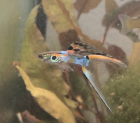
Let's move on to all the beautiful and attractive colors of different types of guppies. The main color is red, but theseguppies can have many other color variations of the body and fins. Solid color guppies are those that have only one primarycolor on their body and fins, usually red, blue, purple, yellow or green. These guppies can be blue, yellow, red and even black and are characterized by having a solid color on both the body and thefins. Bicolor guppies have a light base color that can be red, green, blue, or any other color that does not fit the abovecolor categories. Moscow guppies are usually plain; most often they are black, blue, green or purple. A variety of the Moscow guppy has a platinum coloration of the entire body, caudal and dorsal fins, as well as the tail.Purple guppies have a deep blood red color that gives them a striking, eye-catching appearance; even among wild flowers andpatterns characteristic of guppies. These little guppies often have amazing color schemes such as blue, red or orange thatreally bring their unique pattern to life. They are available in blue, red, orange and yellow with vibrant patterns and exceptional brightness. These are beautifullittle fish that come in many colors and varieties. Onion guppies have a two-tone pattern that uses any color other than thestandard mid-black. They have red eyes and wide tails that can display bright colors like blue and pink. Golden guppies are two-colored fish, butthey can also have a pattern on the body or tail. Veil-tailed guppies are often bi-colored or multicolored, with blue showingthe hindquarters or tail. Bred from the Endlers line, Veiltail guppies have a vibrant deep blue color that is very similar to the blue of wild fish.Endler's guppies are more similar in appearance to wild fish, but still show a greater variety of color and tail shape thantrue wild species. Breeding true green guppies is extremely difficult, as most fish are actually two-tone blue-green or showpurple in different lighting conditions. Mosaic Guppies are a beautiful line of fish that are difficult to care for as the coloration often fades after severalgenerations. The Half Black Guppies are also quite colorful, especially the blue, purple and green types, because the colorscontrast very nicely. Red and black always look striking next to each other, so you can imagine that a half black and redguppies are quite a beautiful fish with a half black, half blood red body. Panda guppy is usually lighter or white in colorwith darker black or dark blue markings. The caudal and dorsal fins are a brighter orange-red, while the body of the fish is dark in color all the way to this centralpart of the guppy where it glows. Perhaps one of the most beautiful fish in the half-black guppies category, it has a half-black body and bright purple finsand tail. These rare and beautiful guppies have a black body with a dark purple fin and tail, which creates a rich and regalappearance. These little guppies have large tails in a wide variety of colors and patterns; it all looks amazing as theyswing and glide through the water. Bizarre guppies have a pattern that vaguely resembles the color of a panda bear, with adark black coating on half of the body, dorsal fins and tail, as well as ringing eyes. Male guppies come in a wide variety of iridescent and metallic colors and patterns, but their distinctive feature is usuallytheir whimsical tails. Fancy or common guppies are also sometimes referred to as rainbow fish or million fish because theycome in a wide variety of colors and shapes. For the sake of simplicity, I will divide guppy fish species into 55 groups based on their species, tail shape, body and eyecolor, and a few other unique traits. When introducing a guppy type, breeders classify it based on color, body and tailpattern, and fin type. The three main coloration types are metallic, solid and albino, but there are also two others used byguppy associations. Albino guppies can be pure white or appear pink or reddish. Neon blue guppies usually have a brighter hue, but they are alsoavailable in red. Snake guppies are often available in vibrant colors such as blue, red, orange, green, and more. Whenconsidering body patterns with flowers, solid blue-tailed snake skin can be rare, as can a yellow guppy that is geneticallygolden with gunmetal head features. Jarawee Lazuli guppies have bright blue heads, which is a rare trait caused by an additional color gene. The reason albinoguppies don't have the rich, vibrant colors that we're used to seeing in guppies is because their bodies don't produce theblack pigment melanin. The yellow-brown coloration of these fish can be preserved mainly in medium-sized guppies, and adecrease in the content of black melanin is required to maintain their coloration. Smaller or medium sized guppies bestexhibit the deep black color that breeders look for in this variety of guppies, while breeding larger guppies will result ina loss of black body color, making these fish difficult to breed.


 Download